
Sussex County Reacts to Volunteer Firefighter Training
Randy K. Trimmer
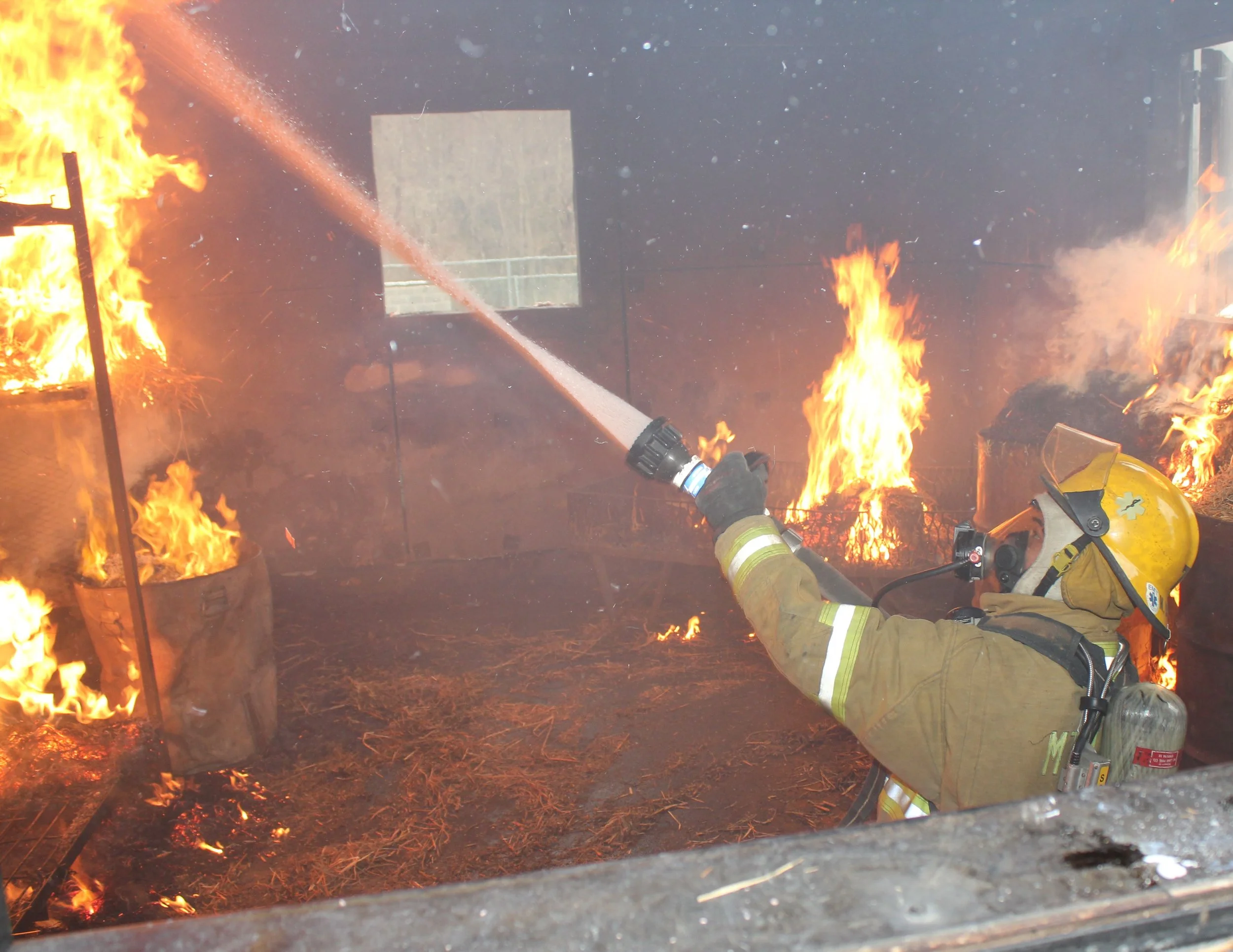
Photo by RK Trimmer
In Sussex County, the sirens still sound—but fewer volunteers are answering the call, leaving local fire departments searching for solutions to sustain emergency services.
This trend extends throughout the United States, where volunteer fire departments face a decline in the number of firefighters. According to National Fire Protection Association statistics (NFPA, 2023), there are 635,000 total volunteer firefighters in the nation. This represents 65% of all U. S. firefighters. (National Volunteer Fire Council, 2024). From 1983, when the NFPA began tracking number of personnel, there were 884,600 volunteers.
This downward trend amounts to about 25% of the total number of volunteers. In this same period, the population in this country increased by approximately 40% with the emergency call volume more than tripling. (NVFC, 2024). This decline threatens rural communities, where volunteers provide fire protection entirely.
Rural towns are facing difficult choices about safety, budgets, and the future of their fire services. The NVFC estimates that volunteer firefighters contribute approximately $46.9 billion per year in donated time and service to their communities. (NVFC Fire Service Fact Sheet, 2024). This figure reflects the replacement cost of equivalent career staffing at current wage rates. Communities that lose volunteer departments are faced with the choice of having reduced fire protection coverage or transitioning to paid staffing, which would have a significant budget impact for smaller municipalities.
All 24 of Sussex County’s municipalities are served by volunteer fire departments.
Sussex County Public Safety Training Center Director, Chief John Dixon, and Deputy Chief–Operations, Gary Crift recently spoke about these challenges and how they are being addressed.
Dixon explained there are multiple factors for the shortages.
1. Economic Pressures: More people are working multiple jobs or commuting long distances, making responses to calls during the day and even nighttime harder.
2. Time Demands: Modern firefighting requires significantly more training hours than previous generations. NFPA 1001 (Firefighter Professional Qualifications) and state certification requirements have increased the time commitment substantially. In addition, once receiving basic training the volunteer member is required to attend department meetings, ongoing drills, fund raising events and participate in many other duties at the station. Potential volunteers struggle to balance these demands with work and family responsibilities.
3. Increased Call Volume: Emergency call volume has tripled over the past 40 years. This increases the time demands of active volunteers without a corresponding increase in personnel.
4. Aging Volunteer Base: In communities under 2,500 population, 53% of firefighters are over 40 and 32% exceed age 50 (NFPA 2017 Fire Department Profile). Long-serving members are retiring, and younger recruits are not replacing them at the same rate.
How has the Public Safety Training Center reacted to the challenge?
After a thorough study on how to implement it, Dixon and his staff have combined Firefighter 1 and Firefighter 2 courses into one. The training hours remain the same to meet the New Jersey Division of Fire Safety certification requirements, but the course is presented within a shorter calendar period. Previously a recruit would complete the Firefighter 1 training over eight to nine months and then return for an additional five months to earn a Firefighter 2 certification.
With the new system, recruits attend classes on Tuesday and Thursday nights as well as a full day on Saturdays. At the successful completion of the course approximately five months later the recruit has certifications in both Firefighter 1 and Firefighter 2.
Dixon described it as “Rip the band-aid off once.”
Dixon related that the county is receiving the change well and it is not impacting recruitment negatively. Dixon said, “I believe the students appreciate and enjoy it,” referring to the combined training.
The academy has become increasingly more important, as though fires are declining, injuries and deaths to firefighters are increasing.
The chief said, “Education and training are what’s going to keep folks alive.”
Personnel instruct at the academy and try to add a form of realism to the training. They try to give firefighters what they need in just the right amount of time.
The academy offers much more than basic training. Continuing education subjects include a variety of live fire events to help firefighters maintain their skill sets. Courses are held focusing on Fire Officer and Chief Fire Officer development. The Academy is multi-disciplinary, offering subjects for police, Emergency Medical Services, public safety dispatcher, local industry, and the public.
The PSTC is a part of the Sussex County Community College. This school is Fire and Emergency Services Higher Education (FESHE), compliant. The FESHE Recognition certificate is an acknowledgement that a collegiate emergency services degree program meets the minimum standards of excellence established by FESHE professional development committees and the National Fire Academy. SCCC is the only community college in New Jersey that offers a two-year associate’s degree that the student can carry over to any four-year college in the country.
“We are very fortunate to be part of the college,” said Dixon. In the past three years, the college, in partnership with the Sussex County Commissioners, has invested significantly in the academy. Having modern, up-to-date equipment and facilities is a plus in attracting and training recruits.
A certificate program for junior and senior high school students is currently in the development stage. Plans include classes in criminal justice, fire science, EMS, dispatch and homeland security. An Emergency Services certificate would be earned by the graduate, which would count towards college credit.
The PSTA will be holding an Open House on June 13. Academy resources for training will be exhibited. Firefighter recruit evaluations will be conducted on this day.
The academy is located at 114 Morris Turnpike, Newton. The public is cordially invited to attend the event. For more information contact Dixon at jdixon@sussex.edu.
Dixon said, “We want to do our part to help to increase volunteerism.”
